


Jane Salihu
The Independent National Electoral Commission (INEC) is strengthening its digital surveillance and deepfake detection capabilities ahead of the 2027 general elections, as it moves to prevent artificial intelligence-generated misinformation from influencing voters and undermining electoral credibility.
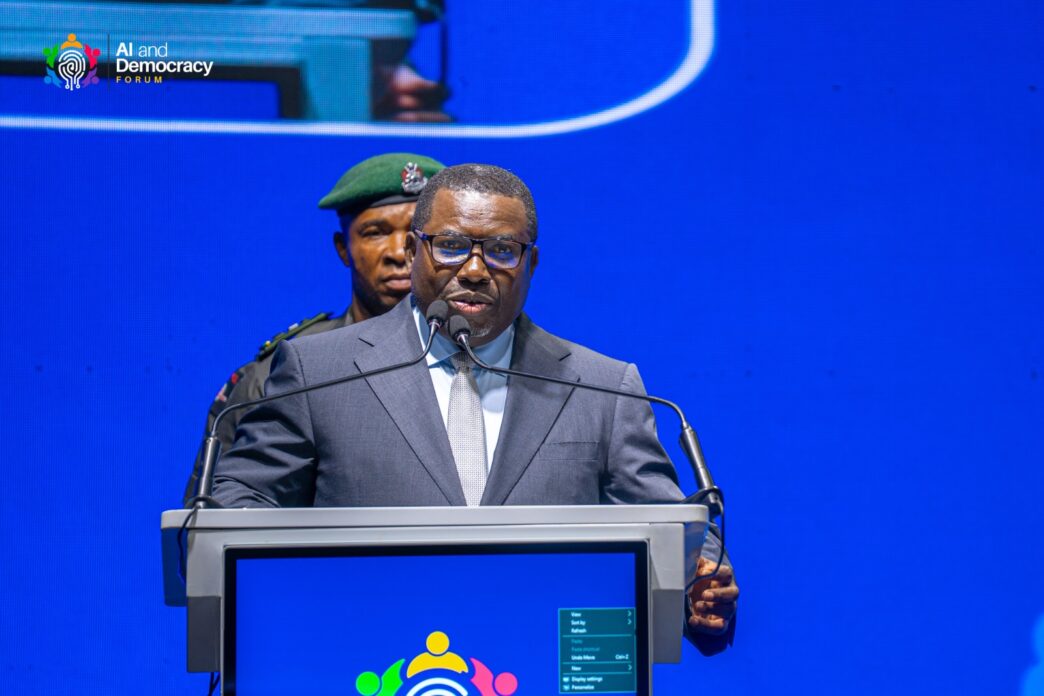
INEC Chairman, Prof. Joash Amupitan, SAN, disclosed this on Wednesday in Abuja at the Artificial Intelligence and Democracy Forum 2026, organised in collaboration with Yiaga Africa, where he announced that the Commission had established an AI Unit within its ICT Directorate to monitor digital threats and detect attempts to manipulate election-related information.
Amupitan said the growing sophistication of artificial intelligence had introduced new challenges to election management, warning that fabricated videos, cloned audio recordings and false electoral announcements could spread rapidly online and mislead voters before the Commission could respond.
He stressed that the outcome of the 2027 elections must reflect the will of Nigerians rather than the influence of algorithms or digitally manipulated content.
“Algorithms will not, and must never, decide the 2027 vote,” he declared.
According to him, the greatest danger lies not only in attempts to compromise electoral technology but also in manipulating the information voters rely on to make informed decisions.
“The greatest threat we face is not the hacking of a ballot box, but the hacking of the voter’s mind,” he said.
The INEC chairman warned that malicious actors could deploy AI-generated videos or cloned voices to impersonate candidates, election officials and security personnel, spreading false information about candidate withdrawals, election postponements and voting procedures.
He said such content could undermine public confidence in the electoral process, particularly when voters are unable to distinguish between authentic statements and synthetic fabrications.
To address the challenge, Amupitan said INEC’s newly established AI Unit would deploy real-time digital monitoring tools, deepfake detection software and data analytics to identify emerging threats and information manipulation targeting the elections.
He added that the Commission was developing a digital strategy to monitor the electoral information environment and working with technology platforms to facilitate the rapid identification, labelling and debunking of AI-generated content relating to elections.
The INEC chairman, however, maintained that the technology also offered opportunities to improve election administration, including logistics planning, voter registration, result verification, cybersecurity and voter education.
He explained that AI-powered geospatial analytics could help the Commission determine efficient routes for transporting election materials and deploying personnel to 176,846 polling units, taking into account traffic conditions, weather forecasts, road accessibility and security concerns.
On electoral integrity, he said artificial intelligence could support statistical audits of polling unit result sheets uploaded through the INEC Result Viewing Portal, helping to identify mathematical inconsistencies, unusual entry patterns and image-quality defects for further administrative review.
Amupitan clarified that such technological assistance would not replace the statutory role of human officials in result collation and declaration.
He said no critical electoral decision, including result collation, voter accreditation and candidate qualification, would be fully automated or transferred to an autonomous system.
“Human accountability, statutory oversight and judicial review will remain paramount at every stage of the electoral chain,” he stated.
The chairman also disclosed that AI-enhanced biometric identification systems were helping to detect duplicate facial and fingerprint records in the National Register of Voters, which contains more than 103 million registered voters.
He said the Commission was exploring natural language processing tools to translate voter education materials and other electoral information into indigenous languages, including audio formats accessible to visually impaired and low-literacy citizens.
Amupitan called on technology companies, political parties, civil society organisations, the media and security agencies to strengthen cooperation against digital election interference.
He urged platforms including Meta, X, Google, TikTok and Telegram to act swiftly against unlabelled synthetic media impersonating electoral officials and candidates, enforce appropriate disclaimers on political advertisements and restrict micro-targeting based on ethnicity, religion and local origin.
He also proposed expanding an Electoral Information Integrity Coalition involving INEC, civil society groups, media organisations, fact-checkers and telecommunications operators to identify and counter viral falsehoods.
Political parties and candidates, he said, should adopt an Ethical AI Code of Conduct prohibiting the use of deepfakes, synthetic impersonation, deceptive advertisements and automated bot networks during campaigns.
The Commission also plans to work with the National Orientation Agency, civil society organisations and the media to promote AI media literacy as part of voter education, encouraging citizens to verify sensational information before sharing it.
Amupitan said the judiciary should prepare for disputes involving AI-generated evidence, while media organisations should establish digital forensic capacity to authenticate user-generated content before publication.
He noted that INEC’s ongoing technological reforms, including the Bimodal Voter Accreditation System and the INEC Result Viewing Portal, formed part of efforts to strengthen electoral transparency and reduce opportunities for manipulation.
The chairman added that the Commission had digitised candidate nominations, processed more than 15,000 nominations across 22 political parties, introduced online voter registration and procured additional BVAS units ahead of the 2027 elections.
He said ten of the 14 major operational milestones under the Electoral Act 2026 had been completed.
The two-day forum, themed “Safeguarding the 2027 General Elections in the Age of Artificial Intelligence”, brought together electoral officials, political party representatives, civil society organisations, technology firms, security agencies and media professionals.
Among those in attendance was the Chairperson of the Economic Community of West African States Network of Electoral Commissions and Chairman of Senegal’s Electoral Commission, Mr Abdoulaye Sylla.





GIPHY App Key not set. Please check settings