


Jane Salihu
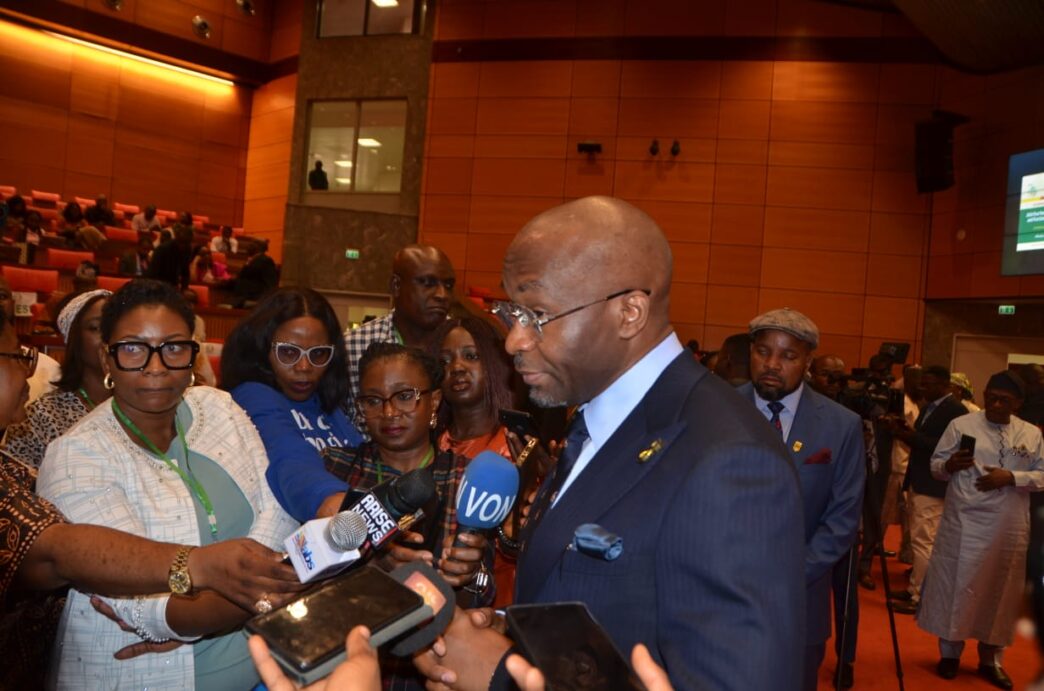
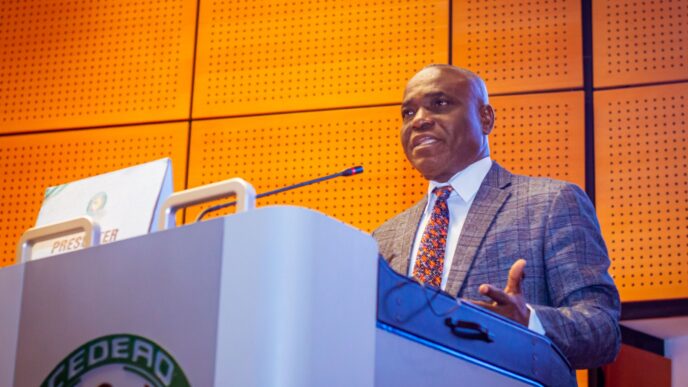
The Deputy Speaker of the House of Representatives, Hon. Benjamin Kalu, has called for a strategic shift toward digital payment systems and improved infrastructure to accelerate trade within the Economic Community of West African States (ECOWAS).
Hon. Kalu, who is also a member of the ECOWAS Parliament, spoke with journalists on the sidelines of the ongoing First Extraordinary Session of the ECOWAS Parliament in Abuja, with a theme “Deepening Regional Integration through Infrastructure Development and Trade Facilitation,” noting that trade among ECOWAS countries remains significantly low. “At the moment, Africa, especially ECOWAS, is trading more with other parts of the world than we are trading with ourselves,” he said, adding that intra-regional trade stood at about 11 percent in 2025.
Hon. Kalu attributed the low trade volume to persistent infrastructure deficits across the region, particularly the failure to develop and sustain key transport corridors. “The various corridors that are supposed to be open and sustained to increase this trade are not happening,” he lamented.
He also decried excessive bureaucratic bottlenecks at border points, describing delays in clearing goods as a major barrier to trade. “These trucks, after 14 hours, get to the borders and stay another 14 hours before they are cleared. It is affecting trade,” he said.
While acknowledging long-standing discussions on a common ECOWAS currency, the lawmaker proposed that the region should explore digital currency and payment platforms as a more pragmatic alternative. “While we struggle with whose head will be on the currency, I think it is about time we begin to think about digital currency and digital payment platforms,” Kalu stated.
According to him, digital payment platforms would significantly reduce reliance on dollar-denominated transactions, which currently cost the region billions of dollars annually. “Most of our dollar-denominated transactions are costing the ECOWAS region about five billion dollars in charges. We are going to save that,” he said.
Responding to concerns that digital payments could sidestep the issue of inflation and currency convergence, Kalu argued that increased intra-regional trade and production would help reduce inflationary pressures. “If we start trading with ourselves, productivity and production in Africa will increase, and the ripple effect is that inflation goes down,” he explained.
Using the cocoa and lithium sectors as examples, he advocated for nearshoring and value addition within Africa. “If I convert cocoa farms into chocolate factories, what I will export will be chocolate, not cocoa. If I convert lithium mines into battery factories, I can exchange batteries instead of raw minerals,” he said.
The lawmaker said that fixing infrastructure, strengthening payment systems, and promoting local production are critical to transforming the African Continental Free Trade Area (AfCFTA) from policy commitments into tangible economic benefits. “Let’s fix the infrastructure, fix the payment system, and trade will boom in ECOWAS,” he said.

GIPHY App Key not set. Please check settings