


Jane Salihu
The Nigerian Senate has ordered an investigation into prolonged airspace restrictions occasioned by the movements of Very Important Personalities (VIPs), amid growing concerns that poor coordination by aviation authorities is endangering passengers, disrupting commercial flights and exposing the aviation sector to avoidable risks.
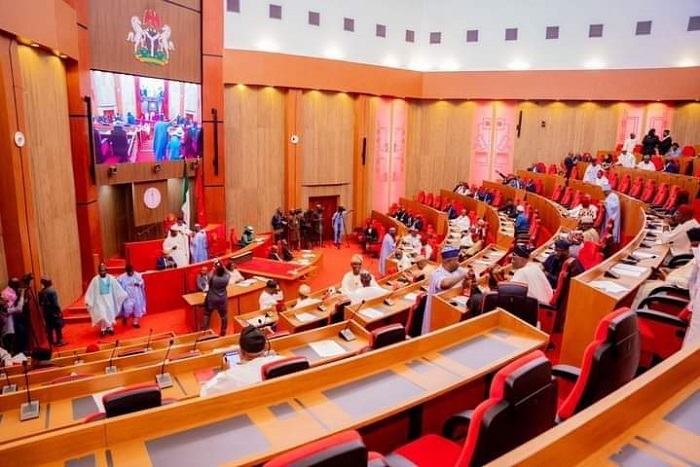
The decision followed a motion sponsored by Senator Isah Jibrin representing Kogi East during plenary on Tuesday, which drew attention to the increasing disruption of commercial flight operations whenever VIPs, particularly top government officials, are expected to arrive at or depart from airports.
The Senate expressed concern that aircraft are sometimes left circling in the air for extended periods while awaiting clearance, while passengers at airports are subjected to lengthy delays without adequate explanations.
In response, the Red Chamber mandated its Committee on Aviation to investigate the circumstances surrounding the restrictions and interface with the Nigerian Civil Aviation Authority (NCAA), Nigerian Airspace Management Agency (NAMA), Nigerian Safety Investigation Bureau (NSIB) and Federal Airports Authority of Nigeria (FAAN).
The committee, chaired by Senator Abdulfatai Buhari, is expected to submit its findings within two weeks.
The Senate also urged aviation authorities to consider diverting aircraft to alternative airports instead of keeping them airborne for hours while waiting for airspace clearance.
Contributing to the debate, Senate President Godswill Akpabio described the situation as a consequence of poor coordination between aviation authorities and officials responsible for managing VIP movements.
Recalling his experience as a governor, Akpabio said there was an occasion when passengers were kept inside a bus for about three hours while waiting to board an aircraft because of restrictions associated with VIP movements.
He explained that airspace restrictions were sometimes imposed long before the arrival or departure of the VIP concerned, resulting in unnecessary delays for commercial airlines.
According to him, the situation becomes more complicated when restrictions are activated before the President has even completed engagements at the airport or commenced his journey.
Akpabio said aircraft were often left circling in the air while passengers waited at airports, describing the practice as avoidable if aviation authorities properly coordinated their operations with the actual movement of VIPs.
He maintained that restrictions should be timed to correspond with the movement of the VIP rather than imposed several hours ahead of schedule.
The Senate President also raised concerns over reports that a recent aircraft crash in Nigeria may have involved fuel exhaustion while the aircraft was hovering in the air awaiting clearance.
However, he clarified that he had yet to receive the final report establishing the actual circumstances of the incident.
He consequently directed the Senate Committee on Aviation to immediately convene a meeting with the relevant agencies, describing the situation as a threat to human lives.
Akpabio further tasked the committee to establish whether airspace restrictions were extended to other categories of VIPs apart from the President.
Also contributing, Senator Diket Plang, representing Plateau Central, called for better coordination of flight schedules, arguing that commercial aircraft should not be cleared for take-off to destinations where airspace restrictions have already been scheduled for VIP movements.
Plang, who recalled his experience as a station manager with Kabo Air in Kano in 1996, said aviation authorities must pay closer attention to flight schedules, take-off and landing times to prevent avoidable operational conflicts.
He warned that poor management of airspace could result in serious safety consequences, particularly where aircraft are forced to remain airborne longer than planned.
The senator also drew attention to aviation safety regulations requiring aircraft to carry sufficient fuel reserves to cater for emergencies, including situations where they may have to return to their departure airports.
Similarly, Senator Abdul Ningi, representing Bauchi Central, described prolonged flight delays as a recurring problem requiring urgent intervention by the National Assembly.
Ningi blamed the situation on weak supervision and the failure of aviation regulatory agencies to enforce operational standards, insisting that lawmakers must take responsibility for ensuring that the agencies discharge their duties effectively.
He cited a recent experience in which a journey from Kano, ordinarily expected to last about 40 minutes, took two and a half hours because of airspace-related delays.
The senator lamented that passengers were frequently left without explanations whenever flights were delayed for several hours, adding that the absence of effective complaint channels had worsened public frustration.
He said the National Assembly, which exercises oversight over aviation agencies, must ensure that appropriate measures are taken to address the recurring disruptions.
The Senate’s intervention is expected to place renewed scrutiny on the management of Nigeria’s airspace, particularly the balance between security arrangements for VIP movements, efficient commercial flight operations and the safety of passengers and crew.



GIPHY App Key not set. Please check settings